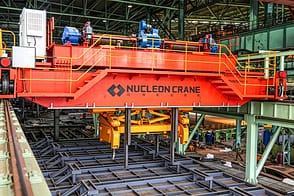





Automotive EMS chain hoist selection cannot be based on lifting capacity alone. Body, paint and final assembly shops operate under completely different conditions, and each workshop consumes lifting equipment in a different way.
When an EMS stops unexpectedly, maintenance teams often inspect the rail, control system and traveling trolley first. After completing these checks, they may eventually discover that the problem lies in a less noticeable component: the chain hoist.
The rail remains fixed, the scheduling function is handled by software and the trolley is mainly responsible for traveling. The lifting unit, however, performs mechanical work during every cycle. Its motor starts and stops, gears transmit torque, the chain moves under load and the brake repeatedly applies and releases.
This continuous mechanical activity makes the chain hoist particularly vulnerable to fatigue and wear.
Why the Automotive EMS Chain Hoist Faces Different Demands
Vehicle manufacturing generally includes stamping, body welding, painting and final assembly.
EMS use in stamping areas is comparatively limited. The greater chain-hoist challenges are concentrated in the body, paint and final assembly shops—and the operating conditions in these three areas are fundamentally different.
Body Shop Automotive EMS Chain Hoist Requirements
Body shops involve frequent starting, stopping and lifting. Some stations may complete large numbers of operating cycles during every production shift.
Welding spatter and airborne dust add further stress to the equipment. The motor repeatedly accelerates, the chain experiences changing loads and the brake engages during every positioning movement.
Important selection factors include:
- Hoist duty class
- Starts per hour
- Motor duty and thermal performance
- Load spectrum
- Chain and brake durability
- Protection from dust and welding spatter
A light-duty hoist may provide sufficient rated capacity while still being unsuitable for the operating frequency of a body shop.
Paint Shop Automotive EMS Chain Hoist Requirements
Paint shops create a different challenge. Heat, humidity, paint mist and process-related contaminants can affect the motor, electrical terminals, chain and other components.
If sealing and equipment protection are insufficient, long-term exposure may accelerate corrosion and component aging.
Paint-shop selection should consider:
- Enclosure and motor protection
- Sealing of electrical components
- Corrosion exposure
- Chain and lubrication protection
- Inspection and maintenance access
An IP rating is an important reference, but it does not confirm suitability for every paint-shop location. The supplier should evaluate conditions at the actual installation point before determining the final configuration.
Final Assembly Automotive EMS Chain Hoist Requirements
Final assembly places greater emphasis on smooth movement and controlled positioning.
Components must often be lifted, lowered and aligned with other production equipment. Abrupt starting, excessive load movement or inconsistent stopping can make alignment more difficult and require repeated operator corrections.
The automotive EMS chain hoist may therefore need:
- Single- or dual-speed lifting
- Smooth low-speed operation
- Controlled acceleration and deceleration
- Reliable upper and lower limits
- Reduced movement during stopping
- Integration with the EMS control system
A conventional single-speed hoist may provide sufficient capacity but still fail to deliver the controlled movement required for assembly operations.
Why One Automotive EMS Chain Hoist Configuration Cannot Fit All
The three workshops test three different equipment capabilities.
The body shop tests operating frequency and fatigue life. The paint shop tests sealing and environmental resistance. Final assembly tests smoothness and positioning control.
Increasing the duty class does not automatically provide better corrosion protection. A higher enclosure rating does not automatically improve low-speed positioning. Smooth speed control does not by itself confirm that the hoist can withstand high-frequency body-shop operation.
This is why one general-purpose configuration cannot fully address all three operating environments.
The problem is not using one brand throughout the factory. The problem is forcing one identical product configuration into three different workshops.
One Brand Can Provide Multiple Chain Hoist Configurations
Using one chain hoist brand across an automotive factory can simplify spare-parts management, technical communication, employee training and maintenance procedures.
However, brand standardization should not be confused with product standardization.
A more suitable approach is to select multiple configurations from one coordinated product family.
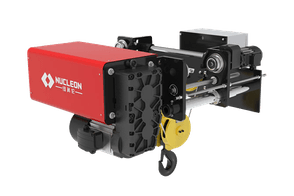
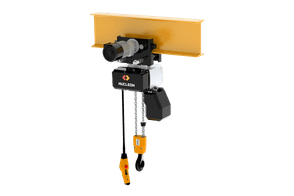
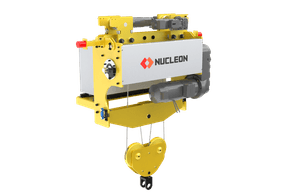
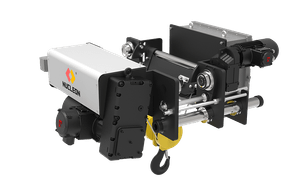
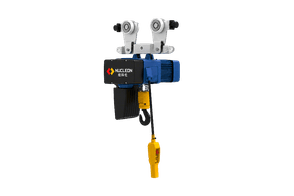
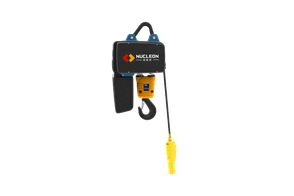
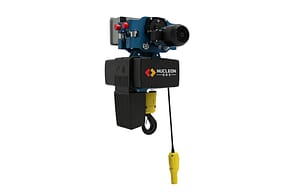
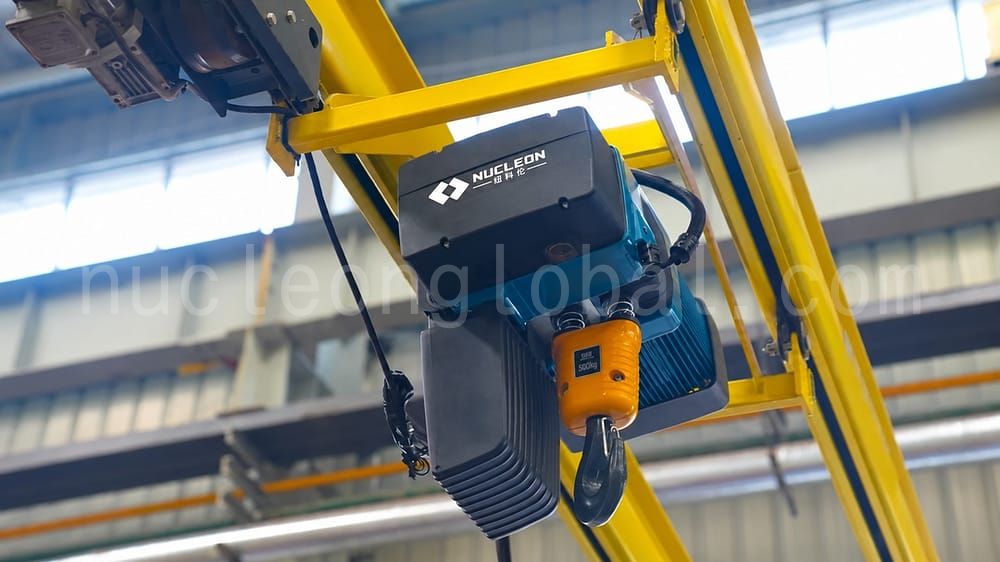
According to Nucleon's published information, the Kipandio cha mnyororo wa umeme cha NHC offers:
- M4–M7 duty classes
- IP55 protection
- An enclosed die-cast aluminum housing
- Standard capacities from 80 kg to 10 t
- Single- and dual-speed motor control
- Variable-frequency traveling control
- Compatibility with multiple rail systems
Other Nucleon application materials also describe selected NHC configurations with capacities reaching 20 t. The final capacity, duty class, controls and protection measures should be confirmed according to the specific application.
Within one product family, a body-shop configuration can prioritize higher operating intensity, a paint-shop configuration can emphasize environmental protection and a final-assembly configuration can focus on controlled movement.
What M5+ Means for an Automotive EMS Chain Hoist
An M5+ classification indicates that the hoist is intended for more frequent operation than light-duty equipment used for intermittent lifting.
Duty classification should not be selected from lifting capacity alone. It must also consider the total number of operating cycles and the load spectrum over the equipment's intended service life. This principle is consistent with the cycle-based classification approach described in ISO 4301-1:2016.
Before selecting an M5, M6 or M7 configuration, buyers should provide:
- Average and maximum loads
- Lifts per hour
- Operating hours per shift
- Number of production shifts
- Lifting and traveling distances
- Required lifting speeds
- Expected service life
This information allows the supplier to match the automotive EMS chain hoist to the actual production cycle rather than relying only on rated capacity.
Match Every Automotive EMS Chain Hoist to Its Workshop
One identical chain hoist for all three workshops may simplify initial procurement, but it transfers the differences between those workshops into future operation and maintenance.
The body shop consumes equipment through frequent operating cycles. The paint shop challenges sealing and environmental protection. Final assembly requires smooth movement and predictable stopping.
The right solution is not three unrelated brands. It is one coordinated product family with configurations matched to the actual conditions of each workshop.
One brand can cover all three workshops—but one automotive EMS chain hoist configuration cannot fit them all.

Mimi ni Novia, ninajishughulisha na usafirishaji wa crane kwa miaka 10, nikihudumia wateja katika nchi 20. Nina akiba ya ujuzi wa kitaaluma kuhusu muundo na utendaji wa aina mbalimbali za cranes. Kutoka kwa nukuu hadi mpango wa kubuni hadi utoaji, nitakupa huduma ya moja kwa moja ili kukupa suluhisho la gharama nafuu na la kitaaluma la crane. Ikiwa unahitaji kununua crane, tafadhali wasiliana nami kwa huduma ya hivi punde.

